● SUTARTIS
Skaityti lietuviškai →Freelance contract template - protection for the self-employed
Working in Lithuania under an individual activity certificate, or hiring someone who does? Agreeing over chat feels convenient until the client stops paying or starts asking for work you never agreed to. A written contract is the only thing that carries weight then - and it matters to the tax authority too, not just in a dispute.
12 EUR · Ready in 5 minutes
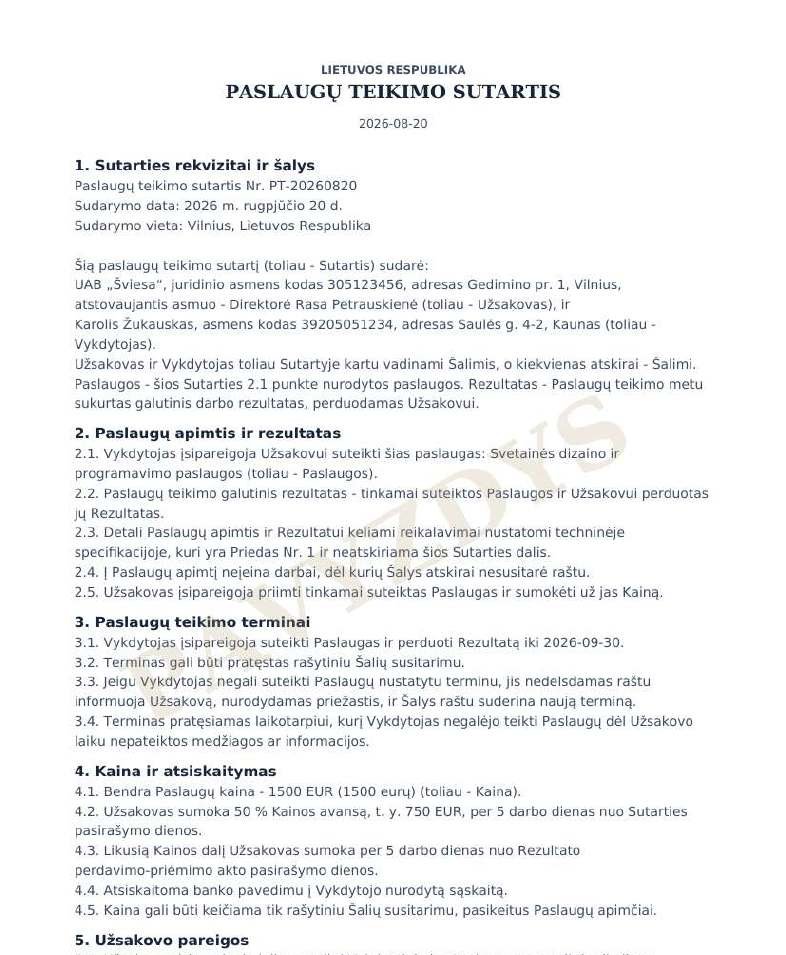
The biggest risk: reclassification as employment
If you work for a single client, on their schedule and with their equipment, the tax authority and the social insurance fund may treat the relationship as employment and apply taxes retroactively - payable by the client, which usually ends the arrangement. The decisive word in the contract is “independently”: the contractor decides when, where and how the work is done. Our template states this in a dedicated clause.
Copyright - why it matters to both sides
Payment alone does not transfer copyright. For the client that means the contractor could lawfully sell the same work elsewhere. For the contractor it means the rights stay with them until full payment - the strongest leverage there is when a client delays. The contract also preserves the contractor's right to show the work in a portfolio.
Payment and invoicing
The common model is a 50% advance with the balance on completion: the contractor is not working for nothing, and the client is not paying for unseen results. State deadlines in actual days - “within a reasonable time” means nothing in a dispute. An invoice is issued for the services, and the income is declared in the annual return.
When is the work considered accepted?
Without a clear deadline for comments, a project can run forever - each “one more revision” looks small. In this template the client has 5 business days to submit comments; if none arrive, the work is deemed accepted. Justified defects are fixed by the contractor at their own expense within 10 business days.
Signed with a qualified electronic signature
Sign with Smart-ID or mobile signature. A qualified electronic signature has the same legal force as a handwritten one; the signing service is provided by Mark ID, UAB, whose information-security management system is certified to ISO/IEC 27001.
Frequently asked questions
Is a written contract required for freelancers in Lithuania?
The law does not demand written form for every engagement, but without it there is almost no way to prove what was agreed. Chat messages are considered by courts, yet they rarely cover deadlines, scope and copyright.
Does the contract protect against reclassification as employment?
It helps considerably, but actual practice decides. If the contract establishes independence and you genuinely work that way - choosing your own time, place and tools, with more than one client - the risk is low. If in reality you work like an employee, wording alone will not protect you.
Who owns the work I create?
Under this contract, economic copyright passes to the client upon full payment. Until then it stays with you. Your right to show the work in your portfolio also remains, unless agreed otherwise.
Does it work with foreign clients?
Yes. The contract can be produced in English or Lithuanian with identical clauses. It states that Lithuanian law applies; with a foreign client that clause is worth discussing separately.
Do I need a technical specification?
It is recommended. Attached as Annex No. 1, it defines exactly what is in scope - which is the prevention of the single most common dispute: “was that included?”
Every clause is explained in plain language inside the tool; the document can be edited, extended with your own clauses and signed with a qualified e-signature. This is not legal advice.